
- This event has passed.
Karwa Chauth Vrat
17 October, 2019
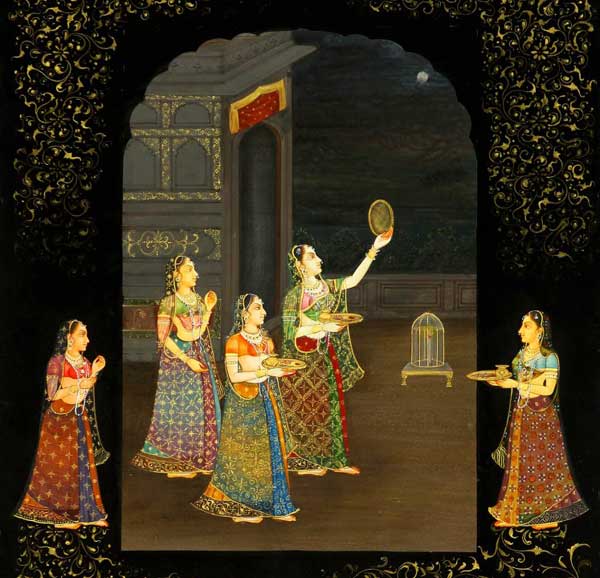
Karwa Chauth is a festival celebrated by women on the fourth day of the waning moon in the month of kartika. On this day, women fast and pray for the long lives of their husbands. The fast begins at dawn and fasting women traditionally do no housework for the duration of the festival. In many regions, women dress themselves beautifully in auspicious colours like red, gold or orange. The day is spent in the company of friends and relatives. In the evening, as they await the moonrise, a female only ceremony is held that involves storytelling and songs. When the moon rises, the custom is for women to view the moon through a sieve or veil, or the reflection of the moon on a vessel of water. She then offers a prayer for her husband’s longevity and the fast is complete.
Another story about the origin of this festival relates to the bond of feminine friendship. With the custom of arranged marriage being prevalent, the newlywed bride would reside with her husband and the in-laws. Everyone being a stranger to her, the custom arose of befriending another woman as her friend (kangan-saheli) or sister (dharam-behn) for life. Their friendship would be sanctified through a Hindu ritual during the marriage ceremony itself. The bride’s friend would usually be of the same age (or slightly older), typically married into the same village (so that she would not go away) and not directly related to her in-laws (so there was no conflict of interest later). This emotional and psychological bond would be considered akin to a blood relationship. It is said that Karva Chauth festival evolved to include celebrating this special bond of friendship.
A few days before Karva Chauth, married women would buy new karvas (spherical clay pots) — 7″-9″ in diameter and 2-3 litres capacity—and paint them on the outside with beautiful designs. Inside they would put bangles and ribbons, home-made candy and sweets, make-up items, and small clothes. The women would then visit each other on the day of Karva Chauth and exchange these karvas.
Traditional tales
There are legends associated with the Karva Chauth festival. In some tellings, the tales are interlinked, with one acting as a frame story for another.
The Story of Queen Veervati
A beautiful queen called Veervati was the only sister of seven loving brothers. She spent her first Karva Chauth as a married woman at her parents’ house. She began a strict fast after sunrise but, by evening, was desperately waiting for the moonrise as she suffered severe thirst and hunger. Her seven brothers couldn’t bear to see their sister in such distress and created a mirror in a pipal tree that made it look as though the moon had risen. The sister mistook it for the moon and broke her fast. The moment she took the first morsel of food, she sneezed. In her second morsel she found hair. After the third she learned the news of her husband, the king, was dead. Heartbroken, she wept through the night until her shakti compelled a Goddess to appear and ask why she crying. When the queen explained her distress, the Goddess revealed how she had been tricked by her brothers and instructed her to repeat the Karva Chauth fast with complete devotion. When Veervati repeated the fast, Yama was forced to restore her husband to life.[34][35]
In a variant of this story, the brothers build a massive fire behind a mountain instead and trick their sister by convincing her that the glow is the moon. She breaks her fast and word arrives that her beloved husband has died. She immediately begins running to her husband’s house, which is somewhat distant, and is intercepted by Shiva–Parvati. Parvati reveals the trickery to her, cuts her own little finger to give the wife a few drops of her holy blood, and instructs her to be careful in keeping the complete fast in the future. The wife sprinkles Parvati’s blood on her dead husband and, coming back to life, they are reunited.[18]
The Legend of Mahabharata
The belief in this fast and its associated rituals goes back to the pre-Mahabharata times. Draupadi, too, is said to have observed this fast. Once Arjun went to the Nilgiris for penance and the rest of the Pandavas faced many problems in his absence. Draupadi, out of desperation, remembered Lord Krishna and asked for help. Lord Krishna reminded her that on an earlier occasion, when Goddess Parvati had sought Lord Shiva’s guidance under similar circumstances, she had been advised to observe the fast of Karva Chauth. In some tellings of this legend, Shiva tells Parvati the story of Veervati to describe the Karva Chauth fast. Draupadi followed the instructions and observed the fast with all its rituals. Consequently, the Pandavas were able to overcome their problems.[35]
The Legend of Karva
A woman named Karva was deeply devoted to her husband. Her intense love and dedication towards him gave her shakti (spiritual power). While bathing at a river, her husband was caught by a crocodile. Karva bound the crocodile with a cotton yarn and asked Yama (the god of death) to send the crocodile to hell. Yama refused. Karva threatened to curse Yama and destroy him. Yama, afraid of being cursed by Pati-vrat (devoted) wife, sent the crocodile to hell and blessed Karva’s husband with long life. Karva and her husband enjoyed many years of wedded bliss. To this day, Karva Chauth is celebrated with great faith and belief.[36]
The Story of Satyavan and Savitri
When Lord Yama came to procure Satyavan‘s soul, Savitri begged him to grant him life. When he refused, she stopped eating and drinking and followed Yama who carried away her dead husband. Yama said that she could ask for any other boon except for the life of her husband. Savitri asked that she be blessed with children. Yama agreed. Being a “‘Pati-Vrat‘” (devoted) wife, Savitri would never let any other man be the father of her children. Yama was left with no other choice but to restore Savitri’s husband to life.[34] This Story refers to a different punima and not Karva Chauth

